


How do we turn product demonstrations into convincing proof?
Turn product demonstrations into convincing proof by testing a buyer's actual workflow against agreed success criteria. Show inputs, outputs, exceptions and human effort, preserve the evidence, and let the buyer inspect or repeat the run. Distinguish demonstrated capability from reliable performance and business impact, which require broader evaluation and credible comparisons.
Turn a product demonstration into convincing proof by letting the buyer inspect their own task: the input, the product’s actions, the usable output and the work left for people. Agree what would count as success before choosing examples. Preserve failures alongside successful runs. A demonstration establishes what happened under the conditions shown; claims about reliability, customer outcomes or business impact need additional evidence matched to those claims.
What does a product demonstration actually prove?
A product demonstration can establish that a specified capability worked for the case and configuration shown. Stronger claims require evidence of repetition, ordinary use, a credible comparison or performance across relevant settings. Treat these as different questions rather than awarding every successful screen share the label “proven.”
Use the following editorial distinctions when deciding what your evidence permits you to say. They are a practical framework for this article, not a certification scheme.
| Evidence available | Claim it can support within its scope | Question still open |
|---|---|---|
| Inspectable demonstration | The product performed this task in this setup | Will another case or user succeed? |
| Defined evaluation across cases | Observed performance across the stated attempts and conditions | Does the evaluation represent ordinary deployment? |
| Measured customer use | These users experienced this outcome during this period | What caused the change, and who else can expect it? |
| Credible comparative pilot | Estimated incremental impact under the design’s assumptions | Does the effect transfer to other conditions? |
| Replication across relevant settings | Evidence for an expected result within a defined population | Where do the result and uncertainty cease to apply? |
Illustrative example: a reporting product assembles a document during a call. That demonstrates assembly. It does not establish factual accuracy, less total staff effort or improved commercial performance. Each additional claim needs a corresponding observation. Start with turning product features into provable sales messages if your promise currently bundles these together.
Read also: making a product roadmap credible to future customers.
Research on persuasion answers a different question. Ringler and colleagues’ study in the Journal of the Academy of Marketing Science reports five studies across product categories and presentation modalities. Process-focused demonstrations increased purchase intentions through the proposed cognitive process; the presence of other audience members attenuated the effects. The publisher’s abstract concerns purchase intention, not measured B2B implementation success or financial returns. It cannot establish that step-by-step demonstrations are universally best.
Buyer surveys also need boundaries. In the TrustRadius 2024 B2B Buying Disconnect survey, 54% of responding technology buyers used a demo, rising to 67% for enterprise purchases. Among demo users, 71% called demos their most influential resource. The vendor-published survey collected verified responses from 2,164 buyers and 243 vendors through the TrustRadius network. These are reported behaviors and judgments within that sample, not estimates of purchases caused by demonstrations.
Which sentence in your current demo asks the buyer to believe more than the demonstration establishes?
Read also: making pricing, process and limitations transparent before buyers choose.
What should we learn about the buyer before preparing a demo?
Demo discovery should identify the buyer’s actual task, current alternative, operating constraints and unresolved decision. Recreate a recent episode in the buyer’s language, then agree which part the product must demonstrate. Personalization should change the test conditions where necessary, rather than merely replacing a logo.
Salesforce Trailhead’s demo guidance recommends starting with a question, focusing the takeaway and showing the journey. That is useful practitioner guidance. Turn it into a preparation record rather than assuming you already know the question.
Example preparation template: for a recurring reporting workflow, complete these fields with the buyer before recording or presenting anything.
| Field | Question to resolve |
|---|---|
| Recent episode | What happened during the last reporting handoff? |
| Current alternative | How were the report and its corrections completed? |
| Useful endpoint | What must the recipient accept before the task is finished? |
| Conditions | Which sources, permissions, formats and deadlines apply? |
| Exceptions | What happens when a source is missing or figures disagree? |
| Decision | Which uncertainty would the demonstration resolve? |
| Rejection | What observation would make this product unsuitable? |
Separate the people who use the workflow from those who authorize or constrain it. Ask an operator about correction and handoff. Ask the sponsor which consequence matters. For the reporting example, ask finance to inspect the time measurement’s assumptions, including whether review and correction count. Ask security or IT to inspect which sources the product reads and whether any data leaves the buyer’s environment. Ask the implementation owner to identify who maintains the integration and what would break if a source field changed. One person may cover several roles; record the responsibilities explicitly.
Do not manufacture one universal success metric by averaging these interests. An operator’s faster preparation does not cancel an unacceptable disclosure of information. An executive’s enthusiasm does not establish that the receiving team can use the output. Ask each relevant owner which conditions are necessary and which improvements are desirable.
If the conversation reveals no recent problem or relevant decision, return to choosing the buyer pain for your first GTM campaign. A focused discovery conversation may be the appropriate next step before any demonstration.
Would your intended user recognize the task, the difficulty and the finish line in the demo you have prepared?
Which demo format should we use for the evidence we need?
Choose a demo format according to the uncertainty it can resolve. A recording can explain a workflow; a buyer-operated environment can reveal usability and prerequisites; a pilot can investigate ordinary operation over time. Production behavior must be evaluated in the actual product and relevant conditions, even when an interactive representation explains the idea clearly.
The following is a proposed selection guide, not a universal sequence through which every prospect should pass.
| Buyer question | Suitable format | Limitation to disclose |
|---|---|---|
| What does the product do? | Short recording or interactive walkthrough | Selected path; omitted behavior remains untested |
| Can it perform this task? | Guided live run with inspectable input and output | Presenter, setup and case may be unusually favorable |
| Can our users operate it? | Buyer-operated sandbox or limited trial | Training, access and environment may differ from production |
| Does this integration work? | Bounded proof of concept | Technical feasibility alone does not establish operational value |
| Will it improve ordinary work? | Scoped pilot with agreed measures | Observation window and comparison design constrain conclusions |
| Did the result persist elsewhere? | Permissioned customer evidence or reference conversation | Selected experience may not represent this buyer’s conditions |
For an explanation, a plain recording may be sufficient. An alternative such as Storylane’s interactive demos and sandbox environments offers guided exploration and product clones. Treat a clone as a representation of the product: inspect the real integration, permissions and failure behavior separately. Additional presentation tooling also creates another artifact to maintain when the product changes. Recommend it only when exploration helps answer the buyer’s question.
Illustrative sequence: show the finished report briefly so the buyer knows the endpoint. Run one complete task in the product, from source selection to recipient acceptance. Then let the buyer try an unfamiliar report and introduce a missing source. Keep a recording available for absent colleagues, with the evidence record attached. The recording is an explanation of the run, not a substitute for its records.
Do not stage a live technical performance merely to make an orientation video look authoritative. Equally, do not rely on an edited video when the unresolved question is whether the buyer can operate the workflow. Use the simplest format that can answer the decision honestly. If the existing process already meets the need, improving that process may be preferable to evaluating a replacement.
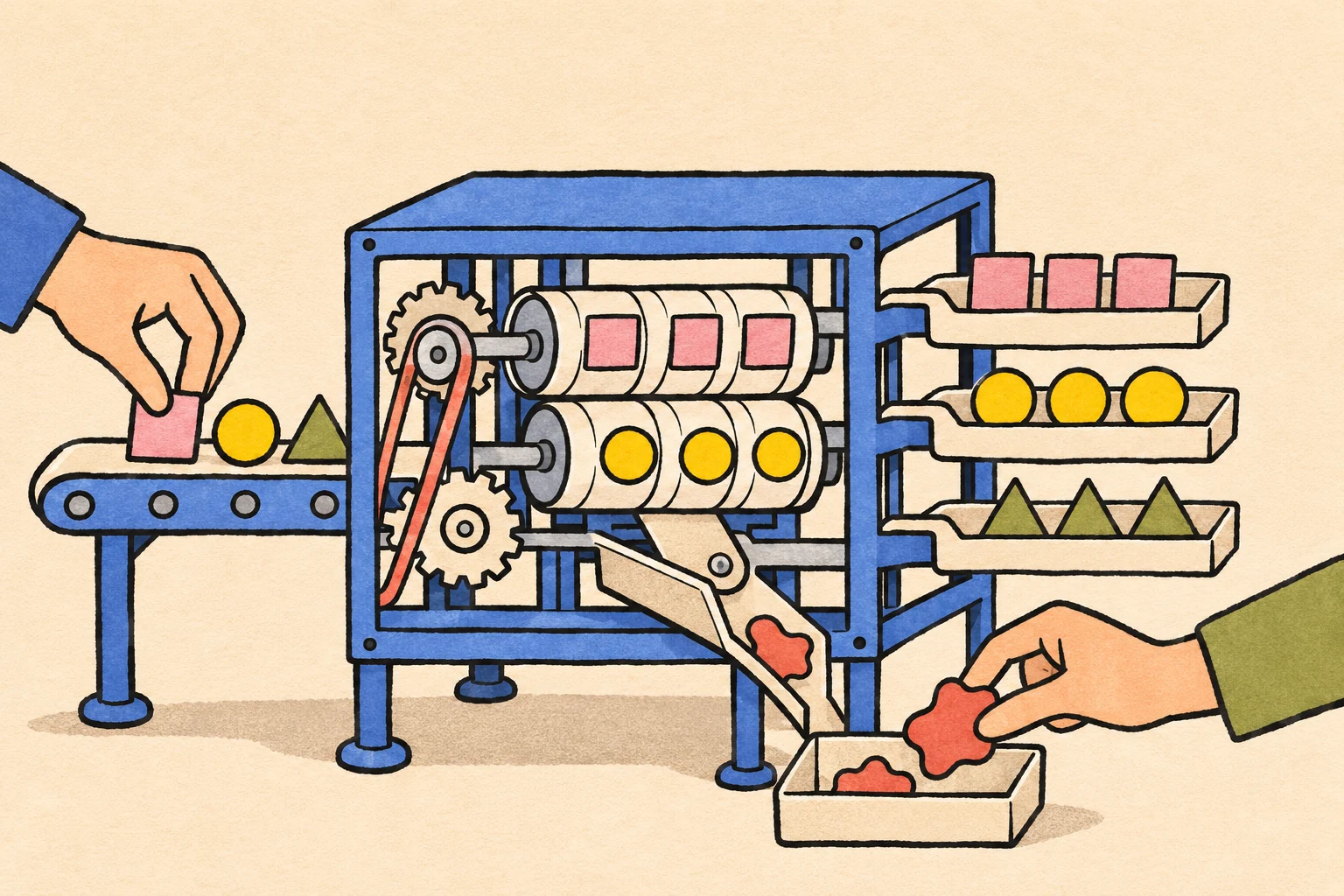 AI illustration: inspect the working process, including the piece that needs human attention.
How do we run a fair, repeatable product demonstration?
A fair product demonstration specifies the claim, case selection, measurement and failure conditions before the run. Preserve enough information for the buyer to inspect the result or repeat the task. The practical protocol below separates evidence from presentation choices; it does not make a small demonstration a statistically validated performance study.
- Write a bounded claim. Identify the user, eligible task and endpoint. Replace “automates reporting” with “produces a draft from these connected sources for an operator to verify.” Keep an unmeasured benefit as a hypothesis.
- Agree the case set. Include ordinary work, a boundary case, an exception and recovery. Explain how cases were chosen and what remains excluded. Buyer-selected fresh cases can challenge a rehearsed path; a deliberately difficult set should be reported separately from a representative sample.
- Record the setup. Save the date, product version, configuration, permissions, connections and presenter. Label synthetic data, simulated integrations, precomputed output and manual assistance before showing them. A prototype should be identified as a prototype.
- Measure the whole task. Start and stop at the same agreed boundaries for both approaches. Count source preparation, waiting, review, correction, retries and handoff. Record whether the recipient accepted the output and whether unresolved work moved elsewhere.
- Preserve every attempt. Keep case identifiers, input, output, timings, interventions and pass or fail judgments. Do not erase a failed attempt when a retry succeeds. Ask another intended user to repeat a relevant case with the support that would actually be supplied.
- Close against the original criterion. Record met, unmet or inconclusive, with reasons. A product change or revised criterion starts a new evaluation version. Keep the original result visible.
This emphasis on documentation is consistent with NIST’s AI RMF Measure Playbook, particularly Measure 2.1 on documenting test sets, metrics and evaluation tools. NIST also calls for measurements under conditions similar to deployment and documentation of limits on generalizability. The protocol here applies that discipline to a sales evaluation; it is not a NIST-approved demo method.
Illustrative arithmetic, not a measured result: suppose a constructed evaluation contains twelve attempts. Nine outputs meet the agreed quality criterion. Two require correction and one remains unfinished. Report nine initial passes out of twelve, preserve the corrections, and report the unfinished task. A time summary calculated only over the nine passes cannot describe total effort across the twelve attempts. State the incomplete task separately rather than quietly removing it or assigning it zero time.
Also distinguish active staff time from elapsed time. A background process can take longer while requiring less attention. Conversely, quick generation followed by lengthy verification may leave no useful capacity. Show both measures where they affect the decision, and compare output quality on the same criteria. Avoid running the new product with expert assistance while giving the existing method an untrained operator.
There is no run count proposed here as sufficient for a reliability claim. Agree the precision and case coverage the decision requires. A second operator addresses dependence on one presenter; it does not, by itself, establish population performance.
Illustrative uncertainty calculation: suppose thirty independently sampled tasks all pass, with a fixed underlying failure probability and a sample size chosen beforehand. Applying the exact binomial method described in NIST’s confidence-limit documentation, the one-sided 95% upper confidence bound on the failure probability is about 9.5%. This is calculated by finding the failure probability at which thirty consecutive passes have a probability of 0.05. Zero observed failures therefore leaves considerable uncertainty in this constructed example.
The calculation does not establish that your tasks are independent, representative or equally difficult. Repeating one favorable input thirty times does not sample thirty different workflows. Choose the evaluation unit and sampling method before selecting the statistical calculation. If the tolerable failure rate is much lower, plan the evidence accordingly rather than borrowing certainty from a larger-looking attempt count.
Which failed or excluded attempt would change the impression created by your current success slide?
What extra evidence does an AI product demonstration need?
An AI product demonstration needs evidence about the evaluated system, relevant inputs, output quality, variation and human intervention. Treat a polished answer as one observation. Build a separate evaluation that can expose missing evidence, unstable performance and unacceptable actions before making a broader claim.
NIST’s Measure Playbook addresses deployment context, representative evaluation, reliability, monitoring and the effectiveness of measurement itself. Use those principles to define a product-specific evaluation. They do not prescribe one universal accuracy threshold or certify an AI product’s sales claims.
Example evaluation plan for a report-drafting assistant:
| Evaluate | Proposed observation |
|---|---|
| Factual support | Compare statements and calculations with the supplied source material |
| Missing information | Submit an incomplete source and inspect how uncertainty is presented |
| Variation | Repeat relevant inputs and retain output differences and retries |
| Coverage | Compare relevant source formats, task types and user groups separately |
| Permissions | Attempt access outside the intended user’s scope in a controlled environment |
| Human effort | Record review, correction, escalation and eventual acceptance |
| Recovery | Inspect the response to an unavailable source or failed connection |
Save the model identifier where available, product version, instructions, connected material and tool configuration. Disclose whether the shown output was generated live, selected from earlier attempts or edited. Keep development examples separate from evaluation examples that were not used to tune the system. If a case prompts a revision, retain its history and use fresh cases to examine whether the revision transfers.
Define correctness before judging outputs. For an ambiguous task, agree a rubric with the buyer and record unresolved reviewer disagreements. Inspect relevant subgroups separately instead of allowing abundant easy cases to conceal a weakness. Select operationally meaningful conditions for latency and load evaluation, and state when those conditions were not evaluated.
Show the boundary between preparing and acting. A report assistant that drafts text is a different proposition from one that sends the report or changes a CRM record. Evaluate the required approval and recovery separately. See human approval in AI marketing workflows for designing that boundary.
Rerun relevant checks after material changes to the model, instructions, source collection or integration. Keep the previous evidence attached to the version it describes. If an important failure could cause serious harm, a short sales evaluation is inadequate grounds for claiming the risk is controlled; involve the appropriate technical owner before proceeding.
What would your system do when the buyer supplies a legitimate case that your presenter has never seen?
How should we structure a proof of concept or pilot?
A proof of concept or pilot should answer a specified unresolved question against conditions agreed by both parties. Define success, failure and an inconclusive result before starting. Make continuation a joint decision informed by evidence, including the option to stop when the product does not fit.
For this article, use “proof of concept” for a bounded feasibility investigation and “pilot” for limited use under intended operating conditions. Specify the scope regardless of the label. A simple permission check may resolve feasibility without a pilot. A pilot is appropriate when the consequential uncertainty requires ordinary users, live handoffs or an operating cycle that a demo cannot reproduce.
Illustrative pilot agreement for the reporting workflow: this is a worked proposal, not a customer case or recommended universal duration.
| Agreement field | Example entry |
|---|---|
| Decision | The reporting owner decides at the agreed review whether to adopt draft preparation for the defined recurring report |
| Scope | Named sources, report type, intended users and receiving team; unrelated report types remain outside scope |
| Baseline | Current preparation and checking process, using the same completion definition |
| Useful improvement | At least one hour less total active staff time per reporting cycle, with output quality maintained |
| Quality boundary | Required facts verified, omissions recorded, no unauthorized disclosure or sending |
| Assistance | Log supplier setup, training and repairs separately; include ongoing human review in staff time |
| Evidence | Source records, attempt log, acceptance decisions and user observations, reviewed by a named buyer owner |
| Stop rule | Suspend use for a disclosure or action outside agreed authority; restore the existing process |
| Mixed result | Repeat only an identifiable unresolved question with a changed method and a new review date |
| Exit | Either side may decline continuation; record the finding and close access and data handling as agreed |
The one-hour threshold is an example choice. Ask the buyer what improvement would actually justify switching and whether your observation window can resolve it. Include setup, migration, integration, training, oversight, redesign and maintenance in the adoption decision. Separate one-time effort from recurring work. Released capacity is not automatically a reduction in expenditure; specify what useful work would take its place before constructing a financial model.
Before claiming impact, ask what would have happened without the product. Gordon and colleagues’ advertising measurement working paper, hosted by Northwestern University, compares observational approaches with fifteen randomized advertising experiments. The observational methods often failed to reproduce the experimental effects despite extensive adjustment. This is advertising research, not a study of product pilots. The methodological inference for a pilot is to examine the comparison design rather than treating abundant observations as proof of causation.
Where feasible, randomly allocate comparable work or teams to the existing and proposed approaches. Account for contamination, learning and differences between operators. A phased rollout needs a valid comparison design before it supports a causal interpretation. If allocation cannot be randomized, a matched comparison or measured baseline may still inform the decision; state the assumptions and unresolved explanations, including staffing changes, seasonality and concurrent process improvements.
Separate evidence collection from the decision to buy. A pilot can show technical feasibility and still reveal unacceptable implementation effort. A positive result can remain too uncertain for a strong public claim. Present proceed, revise, stop and inconclusive as legitimate outcomes. For what happens after acceptance, use turning successful pilots into lasting customer relationships.
Have both sides agreed what finding would justify walking away, as clearly as they have agreed what success would mean?
How can we use customer evidence without overstating the result?
Customer evidence should support the particular claim being made, with its source, method, conditions and permission preserved. A testimonial records a person’s experience or opinion. A measurable performance claim needs underlying evidence; neither a recognizable logo nor an enthusiastic quotation supplies the missing comparison.
The UK CAP Code’s substantiation and qualification rules require documentary support before publishing objective claims and clear presentation of significant limitations. ASA/CAP’s testimonial guidance addresses permission, evidence of authenticity, relevant product context and commercial interests. These are UK advertising requirements, not a claim that identical rules apply everywhere.
The US FTC’s Endorsement Guides FAQ warns that specific endorsed results can imply what others should expect. A generic statement that results vary does not necessarily correct that impression. Check the rules relevant to the audience before using an exceptional result as promotional evidence.
Example evidence record: attach the exact proposed claim to the original observation, measurement definition, case-selection method, period, product version, assistance supplied, limitations, approval and review date. Preserve the customer’s original words and approved presentation. If you cannot verify a performance statement, remove it or narrow the copy to what the available evidence establishes.
For a case study, provide a readable before-state, what changed, the implementation work and the measured outcome. Make the method inspectable through an appendix or controlled access where necessary. Include denominators, unresolved work and relevant variation. An interactive format may help readers explore this material; it cannot repair missing observations. Avoid turning a dramatic visual transition into an unsupported claim of typical improvement.
If you lack customer outcome evidence, publish a clearly labeled demonstration with its protocol and limitations. A reference conversation can answer experience questions, but the buyer should know how the reference was selected and whether commercial relationships matter. Do not substitute invented customer language, imply independence you cannot establish or make participation in publicity a condition of receiving the agreed evaluation.
For a post-seed startup without customer proof yet, use this minimum protocol with your first five prospects: write one bounded claim, let each buyer choose one relevant case, keep an attempt log including failures and assistance, and send a written recap of what happened, what remains untested and the next decision. Start there; use the statistical example above when planning a broader reliability evaluation, not as a threshold for beginning buyer conversations.
Which claim on your site would survive your own evidence record?
What should buyers receive after the demo, and how should we measure progress?
After a demonstration, give the buyer a compact evidence package that supports the next decision without the presenter. Measure what uncertainty was resolved and what authorized step follows. Viewing time, content interactions and meeting attendance are observations about engagement; treat purchase intent and commercial impact as separate questions requiring their own evidence.
Example follow-up package: put a short decision recap beside the recording. State the buyer’s task, the claim evaluated, the result and its limits. Link the run record and accepted output. Identify untested requirements, relevant product documentation and the owner and date of the next decision. Provide a technical appendix for IT, an assumptions sheet for finance and an operating outline for implementation. Keep the central claim and limitations consistent across all versions.
Let the champion explain the conclusion back in their own words. Ask which colleague still needs different evidence, rather than instructing the champion to repeat a sales pitch. Separate public orientation material from restricted evidence. Give absent stakeholders access appropriate to their task, and remove sensitive inputs from broadly shareable recordings.
Maintain a claim register with an evidence owner, source links, version, scope, permission, open questions and review trigger. Automate copying run metadata, scheduling reminders or preparing draft recaps when reliable. Keep interpretation and publication approval with accountable people. Route missing evidence to review rather than allowing an automated follow-up to turn an unfinished test into a positive result.
For each evaluation, record whether the buyer understood the capability and limits, reproduced a relevant task, accepted the agreed criterion or identified a specific obstacle. Record a declined purchase with its reason too. These observations help diagnose the process; they are not interchangeable with a commercial outcome.
If you compare demo formats, define the eligible audience, assignment method, decision metric and follow-up period in advance. Random assignment among comparable opportunities can support a causal comparison when implemented appropriately. Simply comparing viewers who chose an interactive demo with people who did not leaves selection unresolved. Preserve inconclusive findings rather than declaring the format with more views the winner.
Use recurring failures as product feedback. Return the actual case, configuration and unresolved requirement to the responsible team, then examine a revision through the same evidence discipline. The useful output is a better grounded decision for both parties, including a clear decision not to proceed.
Before asking someone to attend a demonstration, give them enough evidence to assess whether a conversation is worthwhile.
How can Poldermarketing help make demos checkable?
Piet Baudoin of Poldermarketing can help a post-seed startup connect its product demonstration to a specific buyer question, a defensible claim and an evidence-based follow-up. He works remotely in Dutch and English with startups building their go-to-market.
Alongside positioning and findability in Google and AI answers, Piet builds and runs AI automations with care: lead follow-up, enrichment and qualification, CRM setup, reporting, content distribution and tool integrations. For this question, that can mean capturing evaluation records, preparing buyer-specific recaps and keeping unsupported claims out of automated follow-up. Product and technical owners remain responsible for validating product performance.
Explore how an engagement is scoped and carried through, or request a no-cost growth scan to identify where the explanation, evidence or next decision needs attention.
Questions people ask
What is the difference between a product demo and a proof of concept?
A product demo shows selected behavior and helps a buyer understand relevance. Use a proof of concept to investigate a specified feasibility question, such as whether a required integration works. Define the question and acceptance conditions explicitly. Neither format establishes ordinary customer outcomes merely because the product performs the selected task.
Should we demonstrate with the buyer's real data?
Use buyer data when its specific characteristics matter and appropriate access and handling arrangements are in place. Otherwise begin with clearly labeled synthetic or sanitized examples. Explain which properties those examples preserve and which remain untested. A recognizable company name or logo adds no evidence that the underlying workflow fits.
How many successful demo runs are enough?
There is no universal run count. Define the decision, case mix, acceptable uncertainty and consequences of failure first. Several repetitions of one easy case answer a narrower question than evaluation across relevant users and difficult cases. Report attempts and failures together. Seek statistical expertise when a consequential performance claim requires a defensible estimate.
Can we use a recorded demo as proof?
A recording can document an observed run when its inputs, configuration, timing, edits and assistance are disclosed. Preserve the underlying output and relevant records so the buyer can inspect them. A recording of selected success does not establish repeatability, production readiness or a result other customers should expect.
What should we do when the demonstration fails?
Preserve the failed run and establish whether the product, setup, test design or missing prerequisite caused the problem. Follow the agreed stop or recovery procedure. Propose a retest only for an identifiable uncertainty, with revised conditions recorded. If the central requirement remains unmet, recommend a different approach or close the evaluation.